
PinnaSOS
Conservation of the critically endangered fan mussel Pinna nobilis in the Aegean Sea
 Conservation of the critically endangered fan mussel Pinna nobilis in the Aegean Sea
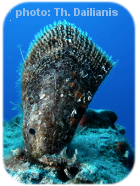
Pinna nobilis is a marine bivalve mollusk, commonly known as noble pen shell or fan mussel. It is one of the largest bivalves in the world and the largest in the Mediterranean Sea, where it is endemic. The average anterio-posterior length of adult individuals is 30-50 cm but it can reach 120 cm. Its lifespan commonly exceeds 20 years and can even reach 45 years. P. nobilis occurs at depths ranging between 0.5 and 60 m. It usually inhabits seagrass meadows but it can also be abundant in macroalgal beds, unvegetated soft bottoms, estuaries or sandy patches among rocky bottoms.
Background
Various human stressors have caused the decline of fan mussel populations across the Mediterranean basin. The species has been formerly targeted for its meat and byssus from which sea silk was produced. It is currently strictly protected under the EU Habitats Directive (92/43/EEC, Annex IV), the Protocol for Specially Protected Areas and Biological Diversity in the Mediterranean of the Barcelona Convention (Annex II), and the national legislation of most Mediterranean countries. Nevertheless, it is still illegally exploited and marketed in many countries. Despite protection, in the last decades its populations have been declining, due to direct threats such as fishing activities and anchoring, illegal collection by divers for food or decorative purposes, and indirect threats such as habitat loss or degradation.

A mass mortality event (MME) of P. nobilis started in autumn 2016 in the SE coasts of the Iberian Peninsula, with mortality rates exceeding 90% within a few weeks. Histological examination of affected individuals showed heavy inflammatory host response and severe general dysfunction By June 2017, the MME had expanded northwards and eastwards in additional locations of the Spanish coastline, in France and Italy. In 2018, similar MMEs were reported in Greece, Cyprus, Turkey, Algeria, Tunisia, Morocco and Croatia with mortality rates often reaching 100%. Two pathogens have been detected and associated with the disease of fan mussel populations: a newly described, highly species-specific cryptogenic protozoon, named Haplosporidium pinnae and a Mycobacterium sp. In Greece, the infection of fan mussel populations was first observed in 2018 and within two years it caused the collapse of most fan mussel populations.
The PinnaSOS project
PinnaSOS aims to protect the remaining Pinna nobilis populations in the Aegean Sea, with a focus on the population of Kalloni Gulf, which is the most important population of the species in the eastern Mediterranean, with an estimate of ~1,000,000 live individuals.
Actions scheduled in the framework of PinnaSOS
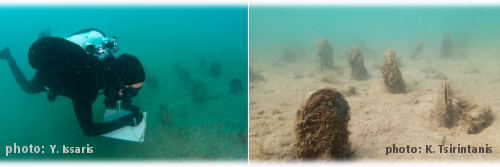
- Exhaustive shallow census in the Aegean Sea, especially in Natura 2000 sites as well as in a large number of other sites in which the presence/abundance of P. nobilis had never been investigated in the past.
- Deep surveys in the Aegean Sea to investigate potential surviving populations.
- Larvae collectors will be deployed to investigate the population dynamics and recovery potential of P. nobilis populations in the Kalloni Gulf.
- Monitoring and mapping of the surviving population in Kalloni Gulf; promoting all needed actions in collaboration with local authorities to establish a protected area, where all boat activities are restricted and any kind of commercial or recreational fishing is prohibited, so that the surviving fan mussel population is adequately protected.
- Dissemination actions to increase public awareness and promote the participation of citizens in the efforts to save P. nobilis from extinction.
PinnaSOS publications
- Katsanevakis S, Tsirintanis K, Tsaparis D, Doukas D, Sini M, Athanassopoulou F, Kolygas MN, Tontis D, Koutsoubas D, Bakopoulos V, 2019. The cryptogenic parasite Haplosporidium pinnae invades the Aegean Sea and causes the collapse of Pinna nobilis populations. Aquatic Invasions 14(2): 150–164.
- Zotou M, Gkrantounis P, Karadimou E, Tsirintanis K, Sini M, Poursanidis D, Azzolin M, Dailanis T, Kytinou E, Issaris Y, Ramfos R, Akrivos V, Spinos E, Dimitriadis C, Lattos A, Giantsis I.A., Michaelidis B, Vassilopoulou V, Miliou A, Katsanevakis S, in preparation. Mass mortality of Pinna nobilis: its status in the Greek Seas.