These are designed to aid recovery of a person overboard.
Τμήμα Ωκεανογραφίας και Θαλασσίων Βιοεπιστημών
- +30 22510 36800
- secr-marine@aegean.gr

RESEARCH VESSELS
Research Vessels
R/V Oceanis
The R/V “Oceanis” is a modern polyester high-speed vessel of the MUNIN S 1200 type which was built in 2023 at the VIKING NORSAFE HELLAS shipyard in Thiva, Viotia, Greece. The vessel’s hull is designed for fast patrol boats and the vessel was modified for oceanographic research use following the requirements of the Department of Marine Sciences in Fall 2023, within the framework of the AEGIS+ project. The vessel was delivered to the University of the Aegean at the port of Mytilene, Lesvos, after crossing the Aegean in Fall 2023.
The vessel is equipped with a LOWRANCE HDS LIVE navigation system, and a VHF/DSC LOWRANCE communication module, along with all the safety equipment required for offshore operations. A GENSET MARINE 5 kva generator provides additional power to support demanding field operations.
R/V “Oceanis” is equipped and certified for operations throught the Aegean Sea and can host up to 10 scientists. She us currently used mainly for research missions. The vessel’s military specifications and propulsion by two MERCURY PRO 300 BHP outboard engines enable safe and fast oceanographic operations at any location of the Aegean Sea.
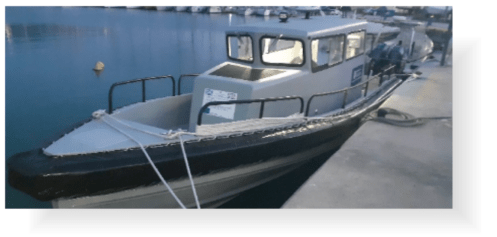
Currently, the deployment and recovery of oceanographic instruments is performed with the aid of a simple crane. The installation of a modern marine crane, a SEAKEEPER gyroscopic stabiliser and a side-deployable arm for the arrachment of either a vessel-mounted Multi-Beam Sonar or an Acoustic Doppler Current Profiler, planned for summer 2025, will boost the vessel’s operational capabilities.
R/V Amfitriti
The R/V “Amfitriti”, was built in 2001 by the OCEAN shipyard in Paiania, Attica, Greece, as a coastal-range vessel designed for scientific and educational use, including survey work, teaching, and research, under the requirements of the Department of Marine Sciences of the University of the Aegean. R/V “Amfitriti” is a Glass Reinforced Plastic (GRP) coastal research vessel, powered by a single 230 BHp Yanmar petrol engine.

The vessel is equipped with two GPS/Radar Plotters (a SIMRAD CA 44 MULTIRADAR and a SIMRAD GO), a SIMRAD PRECISION-9 satellite compass and two VHF/DSC communication modules. Communication between all the navigational and safety instrument is provided by a SIMNET. A FURUNO DFF-3D Multi-Beam Sonar provides bathymtric mapping capabilities.
To support oceanographic operations, R/V Amfitriti is equipped with a 1kW power inverter and a electric-hydraulic winch capable of lifting up to 150 kg. A rotating arm located on the port-side of the boat provides the capability to host vssel-mounted instruments, such as either a Multi-Beam Sonar or an Acoustic Doppler Current Profiler.
The vessel can host up to nine (9) ocean scientists and engineers working in the coastal zone of Lesvos island.
The vessel is routinely used for undregratuate students’ training, under the supervision of the Department’s teaching staff, on sampling methods, in-situ measurements of oceanographic parameters and coastal navigation techniques.
R/V “Amfitriti”‘s greatest advantage is her cost effectiveness and flexibility, as she can operate in waters very close to the shore due to her shallow draft.
R/V Aktaia
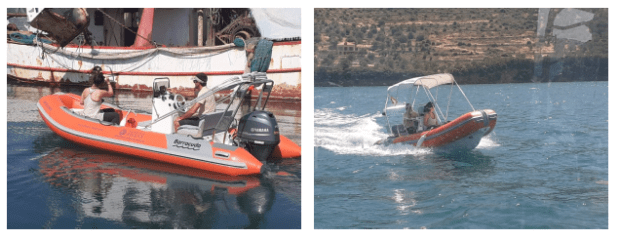
The R/V “Aktaia” is a 4.7 m-long fast inflatable RIB-typ boat, built in 2020 by BARRACUDA shipyard, Athens, Greece for the Department of Marine Sciences in the framework of the project AEGIS.
The boat is powered by a 70 Hp Yamaha outboard and is equipped and certified for research missions in th coastal zone, capable of hosting up to 6 persons.
The R/V “Aktaia” is used mainly for diving support services as wll as small-scale sea-bed mapping work ar very shallow waters near the shore.
The R/V “Αktaia” can be transported to any coastal region on a trailer towed by the DMS’s Mobile Laboratory Van, a MERCEDES SPRIDER 314 CDΙ 4X4.
Services - Chartering
All vessels are solely owned by the Department, and are available for hire by other organizations and institutes or environmental consultants. Costs depend on the equipment required for the application, and interested partners are encouraged to contact the ship’s Master for a quote and service details.
- Specifications
- Scientific equipment
- Educational services
- Research services
- Safety regulations
- Vessel maintenance
- Cruise planning
- Contact information
R/V Oceanis specifications
General specs
VIKING NORSAFE MUNIN S1200
2023
12,5 m
0.95 m
13.73 GRT
16.66 GRT
850 kg
The Aegean Sea
1 - 30 kts
Typically one day
Machinery
2 x Mercury Verado V8 300 BHP each
Generator - GENSET MARINE 5 kVA (12 VDC- 220 VAC) / 1.2kVA Inverter
520 kW – approximately
700 lt
130 lt
Communication and navigation aids
Lowrance HDS Live
Lowrance HDS Live 36 nautical mile range
Head up / North up - true motion dual scale C-Map chart system
HDI SKIMMER /TRANSDUCER 455/800
VHF/DSC Lowrance Link 6 S – EPIRB JORTON TRON 60 AIS
Passengers
Maximum 9 persons on day trips, plus 1 crew member
Working deck & laboratory area
about 5 m2
FASSI M10A AFM.12 HC1 HD4 S2 Class
410 kg at 2,7 meters
Dromec CW 08
Seakeeper 2
800 kg on layer 4
MULTI BEAM or ADCP over the side pole
R/V Amfitriti specifications
General specs
2000
0.88 m
3.23 m
10.53 GRT
13.72 GRT
2000 kg
Local to limited-range daily cruises, up to 10 nm from shore
10 kts
Typically one day
Machinery
YANMAR 230HP
DC 12V - AC 240V / 1100 VA inverter)
335 kW
500 lt
150 lt
Communication and navigation aids
Simrad CA/44 - 14 channel parallel - C/A code - external antenna
Simrad CA/44 - Head up - North Up - True motion dual change - 0.125 - 36 nm range
Head up / North up - true motion dual scale C-Map chart system
Simrad CA/44 1 kW RMS, 50-200 kHz, 600 m range
Simrad RD68 fixed DSC VHF radio, NAVMAN DSC-VHF 70000
Passengers
Maximum 8 persons on day trips, plus 1 crew member
Working deck & laboratory area
5 m2
Electric single drum motor, 12 V, 1000 W
Electrohydraulic servo lift system. Safe working load, 100 kg
R/V Aktaia specifications
General specs
BARRACUDA 482 RIB
2000
4.82 m
0.27 m
2.05 m
925 kg
Up to 3 nautical miles from nearest coast
Typically one day
Machinery
1 outboard YAMAHA F70 70HP
Inverter 220 V / 300 VA
51,5 Kw
80 lt
Communication and navigation aids
SIMRAD Cruise
Head up / North up - true motion dual scale C-Map chart system
Airmar 54 50/200 kHz
Passengers
Maximum 6 persons
Scientific equipment
VALEPORT 106 - SENSOR DATA
3 lt Van Dorn type
SBE19 Seacat profiler
Core sampler KC13570 Denmark research equipment - Van Veen type sediment grab
Barometer, anonometer
Plankton nets assorted sizes
All mobile scientific equipment of the Department (e.g. DGPS, ADCPs, side-scan sonar, split-beam echosounder, etc) can be deployed/operated by R/V Amfitriti.
Please contact the ship’s Master at least 5 working days in advance should you require additional equipment to be installed onboard R/V Amfitriti.
Educational services
Undergraduate courses carried out onboard R/V Amfitriti
Boat safety
The boat safety course covers the main skills necessary to work safely onboard a research vessel, with emphasis on safety and emergency procedures.
Cartography
The Cartography course covers the basic cartography techniques applicable to marine research. Topics include bathymetric chart basics, such as map symbols, contours, elevations, and coordinate systems.
Marine navigation
The course provides a basic background on marine piloting and electronic navigation techniques. Topics include the use of electronic charts, instruments, navigational aids, compasses, nautical publications, radar, GPS, and echosounders.
Marine sedimentology
The course reviews the general characteristics and physical properties of marine sediments, with particular focus on in situ marine sediment sampling methods.
Sampling techniques
Sampling techniques provides training on biological, chemical, physical and geological sampling of coastal marine systems. Topics include the use research equipment and methods for water quality control, as well as plankton or benthic sampling.
Research services
R/V Amfitriti supports various research projects and undergraduate/graduate thesis projects conducted at the Department of Marine Sciences, in topics that range from physical & chemical oceanography, underwater acoustics, or seafloor mapping, to coastal management and water quality assessment.
Michigan State University collaboration
R/V Amfitriti participates in joint educational cruises with Michigan State University students on topics related to coastal navigation techniques, and marine sampling methods.
Safety regulations
R/V Amfitriti is equipped with a full complement of safety systems (life jackets, fire suppression system, life saving apparatus, man over board safety system), as well as navigation and communications equipment; she is further regularly inspected by the Hellenic Coast Guard and certified as a passenger /educational vessel, and operated by a certified Greek Merchant Marine captain.
Nonetheless, these features do not surpass the need for each person oboard to be aware of some basic safety & emergency procedures. If you’re planning to join a research cruise, please spend a minute or two and read the safety onboard guidelines that follows.
The ship's Captain
The Captain manages the organization and operation of the vessel. The Captain has full and final legal responsibility regarding operations and safety at sea and the conduct of all personnel onboard.
Safety rationale
When at sea, just as ashore, most accidents are preventable. However, the environment and working conditions aboard seagoing vessels pose additional hazards not found ashore. The responsibilities to avoid accidents flow from the top down; from the Captain, to each and every individual aboard. “Safety awareness” by all hands is the biggest single factor in reducing accidents.
As a researcher, you are proficient in the demands of your discipline. You have undoubtedly acquired patience and attention to detail when working in the lab to ensure the validity of your research. The demand for such attributes is no less greater when learning to work safely onboard a research vessel.
The “it’s not my job” cliche does not apply at sea. Ashore, you can go home and forget about work and the safety-related aspects of your work surroundings. You can easily follow a different route if there is construction work on your normal way home. A power failure at home is an inconvenience. You are aware of any medical emergency only by the ambulance sirens. Aboard your ship, not only will you need to be aware of any construction or deck operations, you must be able to determine when and where it is safe to pass. A power failure aboard ship can be catastrophic. A medical emergency aboard affects everyone and you may be the only person available to assist the victim.
There is a number of factors that contribute to accidents, and few accidents have a single cause. Some of the major factors contributing to accidents on research vessels are:
- Onboard environment
- Equipment and materials
- Training and experience
- Communications
Good safety practice and habits
Attitude
When onboard, adjust your attitude to adapt to tight working & living quarters and many different types of personalities. Sensible clothing is a part of good safety habits. Wear shoes with non-skid soles, especially on deck. Sandals of any kind are not safe. Shoes should have nonslip soles Sandals are not permitted when working on a wet deck.
Be aware that lines and wires can part under tension. Do not stand under or near a line or wire while it is under a heavy strain. STAY CLEAR. Never step inside the bight (loop) of a line or wire.
Rest
The ability to function properly and to maintain the body’s edurance depends on adequate rest. When fatigue sets in, strength, coordination, judgment, and attitude are adversely affected. If you feel fatigue setting in, inform the Captain immediately.
Diet
A proper diet is necessary to maintain the body’s energy level. Without proper eating habits, fatigue sets in at a quickened pace and resistance to diseases, colds, and infections is lowered.
First aid kits
First aid kits are located throughout the vessel and are equipped with basic medical supplies, including Band-Aids, eyewash solutions, ointments, etc. No matter how small your vessel is, know where these first aid kits are mounted.
Seasickness
If you tend to get seasick, you can dispense appropriate medication one hour before departure, eat dry food and avoid liquids.
Smoking
For reasons of health and safety, smoking is strickly prohibited onboard R/V Amfitriti.
R/V Amfitriti primary and secontary safety equipment
Onboard R/V Amfitriti, you’ll spend all of your time in a coastal environment, some few hundred meters from shore. Do not forget however that the sea can be a magnificent, but also fierce and unforgiving force, capable of sending a ship to the bottom, and its crew “into the drink”. Without the proper equipment to protect you from the weather, provide sustenance, signal rescue resources, and, above all, keep you afloat, the odds are heavily against your ability to survive.
12-person inflatable life rafts
Inflatable life rafts are the primary lifesaving equipment on most research vessels. They are mounted as far outboard as possible, free of overhead obstructions, and high enough to be protected from heavy seas.
12-person buoyant apparatus
A buoyant apparatus is a flat, box-like flotation device with grab lines installed around its edges.
Lifejackets
R/V Amfitriti is equipped with Type 1 adult lifejackets, designed to keep a person face up when in the water.
Ring Lifebuoys
Ring Lifebuoys are the first means of rescue for the person who falls overboard. Lightweight and round, the ring buoy is easy to toss, and will keep the person overboard afloat until help can arrive.
Type V, Man-overboard rescue devices
Vessel maintenance
R/V Amfitriti is regularly inspected by the Hellenic Coast Guard and follows a strict annual maintenance & repair program that ensures the vessel’s excellent working and safety order.
and submit them to:
- Hatzilias Nikolaosmail
- +30 22510 36803
- +30 22510 36809
- nxatzilias@marine.aegean.gr
Please make sure that your cruise request is submitted at least 2 working days in advance or 5 working days should you require additional equipment to be installed onboard R/V.
Chief Scientist notes
One member of the scientific party will be designated as Chief Scientist for the cruise. He or she will be responsible for the coordination and execution of the entire scientific mission and is accountable to the Master for the conduct of all scientific personnel onboard and ashore. The Chief Scientist will work closely with the Master to develop an acceptable mission plan that includes location, depth, tasks, equipment and/or personnel required. With respect to operational safety, he/she must always defer to the vessel’s Master. In practice, the Chief Scientist informs the Master of what he or she desires and unless it is unsafe, illegal, or against accepted procedures, it will be carried out. In addition, the Chief Scientist is responsible for the safe and secure storage of all scientific equipment and the cleanliness of the scientific work areas.
Contact information

- Hatzilias Nikolaos
- +30 22510 36803
- +30 22510 36809
- nxatzilias@marine.aegean.gr